Cooperatives are the path to the economy we desire
Updated: Mar 18
Earlier this month, I read a New York Times article on “desire paths” – the dirt tracks that appear across the grass when the established walkways don’t follow the route that people naturally want to go. “They’re evidence, over time, that an existing design is not adequate,” wrote Melissa Kirsch. “They remind us that we have a choice and that we can veer away from what was laid out for us.”
It made me think that cooperatives are the “desire paths” of our economy. Cooperatives emerge when existing economic systems fail to serve people well — and they remind us that we have the power to build something better.
Food co-ops emerge where families lack access to healthy food.
Rural electric co-ops bring power — and now broadband — to communities investor-owned utilities left behind.
Credit unions keep savings circulating locally.
Workers organize cooperatives for higher wages, better working conditions, and a share of the business’ profits.
Housing co-ops offer greater control and affordability.
Agricultural co-ops allow small and mid-sized farmers to compete and thrive.
Purchasing cooperatives help independent businesses lower costs by pooling their buying power.
Instead of extracting wealth for distant shareholders, cooperatives circulate value locally — building shared wealth for the people who create it.
And cooperative businesses feel more human, actively showing up for their neighbors in need. At the height of the pandemic, worker co-ops converted production to make hospital textiles and sew masks. When hurricanes strike, co-ops across the country – from rural electrics to food co-ops – offer financial assistance through the Cooperative Development Foundation’s Disaster Recovery Fund. And during the tumultuous recent months in Minnesota, Shared Capital Cooperative offered emergency payment relief for borrowers in the state facing disruption. This investment in each other can knit us back together as a society and demonstrate that “we all do better when we all do better.”
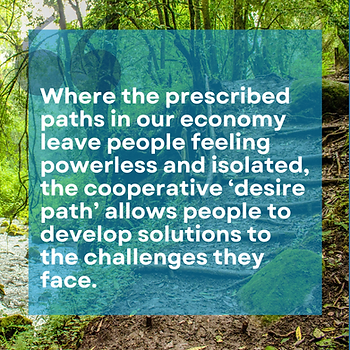
Where the prescribed paths in our economy leave people feeling powerless and isolated, the cooperative “desire path” allows people to develop solutions to the challenges they face, pursue previously overlooked opportunities, build shared wealth, and thrive in community.
CDF is building the capacity of the cooperative business community – investing in emerging cooperative leaders, strengthening the national co-op support system, and supporting communities working to build strong cooperative economies. If you’re ready to invest in an economy that works for all Americans, we invite you to partner with us. By walking the cooperative path together, we will carve a new way forward for our communities and our nation.
Want to stay connected? Follow us on social media (LinkedIn, Facebook, and Instagram) and sign up here to learn about CDF’s upcoming grants, activities, and events, including the upcoming Co-op 5k, which supports cooperative capacity building nationwide.

From the Desk of the Executive Director
Julie Bosland is a results-driven executive with over 25 years of experience helping public, nonprofit and business leaders expand economic opportunities and build strong communities. As executive director of CDF and senior policy advisor to NCBA CLUSA, the apex organization for US co-ops, she supports co-ops and co-op developers nationwide. Previously, Julie served in senior leadership roles within Living Cities, Think Shift (an initiative of The DeBruce Foundation), National League of Cities, and in federal and local government. A graduate of Swarthmore College, Julie earned her Master of Public Affairs from Princeton University and in 2024 earned INP’s Certificate in Nonprofit Practice.


The idea of desire paths makes so much sense when you think about how people actually live. I have seen the same thing with the arrow puzzle and how it helps folks make their own way. Maybe we need more of those paths in our economy, not less.
I recently started using a bulk link opener and it has boosted my productivity, especially while doing research work.
A well-designed platform always focuses on simplicity and ease of use. This platform delivers a clean and easy-to-follow interface. Jaiclub Login helps users understand everything quickly with its clear layout. It is especially useful for beginners who want a smooth experience. The performance is stable and user-friendly. It’s a good choice for those who prefer simplicity.